

Buying another platform won’t, by itself, change how legal work gets done. Legal tech adoption consulting helps legal teams define the problem, choose technology around real workflows, and bring people along through the change. It connects tools, processes, governance, and training so adoption improves legal service delivery rather than simply adding a new system.
Caution is reasonable. AI and automation can reduce repetitive work, but only when teams understand where these tools fit, how outputs will be reviewed, and how to manage data and workflow risks. Without that groundwork, even capable technology can create friction instead of value.
This article explains what legal technology consultants do, how AI and automation can reshape legal services, and why adoption efforts often stall. It also shows how to approach technology selection, implementation, and change by starting with the work itself and building the right support around it.
Key Takeaways
- Start technology planning with the legal work that needs to improve, then shape the solution around existing workflows and governance.
- Use AI and automation where they can support legal teams, with clear human review and practical boundaries.
- Address adoption barriers through visible leadership, role-specific communication, and training that fits how people work.
- Redesign service delivery around client outcomes and the capabilities each matter requires, rather than simply adding tools to existing processes.
What Does a Legal Technology Consultant Do?
Legal tech adoption consulting maps legal work before tools are chosen. Consultants align implementation, integration, governance, and adoption with the firm’s operating needs.
Implementation Timelines and User Adoption
Implementation planning links practice management software with document storage, billing, matter intake, and user access. A single-platform implementation takes 90 days to nine months. Adoption work adds three to six months. Integration count, data migration, workflow complexity, and training shape the schedule. Consultants map roles, sequence testing, and plan rollout around live legal work. Vendors configure products and provide product-specific support. Consultants connect that work to firm processes and adoption plans.
Platform Choices and Adoption Requirements
The options span practice management, document automation, and e-discovery, rather than one universal platform. Choose by function: managing matter intake and tracking, assembling documents, or searching and reviewing large collections. The right fit depends on existing systems, data formats, access controls, and how lawyers handle work. In the U.S., adoption should account for confidentiality, privacy, cybersecurity, and professional ethics obligations. Set rules for data access, review, retention, and human oversight before teams use sensitive information.
Practice management implementation starts by mapping intake, matter opening, deadlines, time capture, and reporting. A consultant can spot duplicate entry and identify which records need to move between systems. The vendor configures its product; the consultant aligns the setup with firm workflows and testing. Test a new matter from intake through billing to keep implementation tied to the function the firm needs.
In the United States, the cost of legal tech adoption consulting depends on the case and is given after a quote request. Scope, integrations, data migration, and training needs shape the work.
Measure ROI against a baseline, such as time spent per matter, cycle time, rework, and tool usage. Compare results after rollout, then break adoption down by role and workflow. High login numbers alone don’t prove value. Track whether automation reduces handoffs or frees lawyer time for work that depends on judgment.
AI, automation, and self-service tools
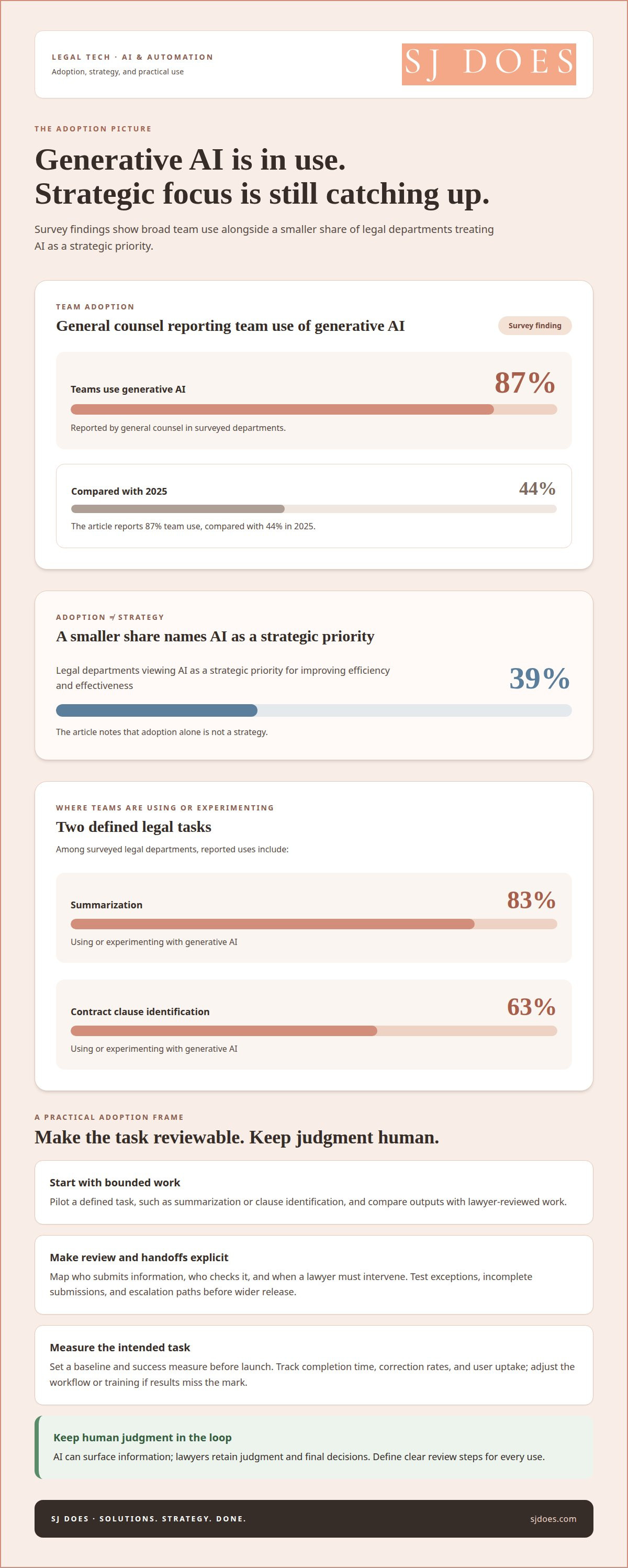
Generative AI is moving into legal departments, but adoption alone isn’t a strategy. In surveyed departments, 87% of general counsel reported their teams used generative AI, compared with 44% in 2025. Yet only 39% viewed AI as a strategic priority for improving efficiency and effectiveness. Selection should start with a defined task, not executive pressure or product hype.
Start with bounded, reviewable work. For example, a team can pilot AI summarization or contract clause identification, then compare outputs with lawyer-reviewed work. Among surveyed legal departments, 83% were using or experimenting with generative AI for summarization, while 63% were using or experimenting with it to identify contract clauses. These uses still need clear review steps. AI can surface information; lawyers retain judgment and final decisions.
Automation handles repeatable steps, while self-service tools guide routine requests into consistent workflows. A contract intake form, for example, can gather key details before routing a request for review. Map the handoffs first: who submits information, who checks it, and when a lawyer must intervene. Then test exceptions, incomplete submissions, and escalation paths before a wider release. The design should reduce avoidable back-and-forth, not create another queue.
For each pilot, define a baseline and a success measure before launch. Track completion time, correction rates, user uptake, and whether the tool supports the intended task. If results miss the mark, adjust prompts, workflow steps, or training before expanding access. Teams are more likely to believe in a tool when its purpose is clear and its limits are visible. Share practical lessons through legal technology content that explains the change in plain language.
Barriers to adoption
Adoption can stall before a tool becomes part of everyday legal work. Deloitte’s survey identified financial and resource limitations as the number-one barrier to generative AI adoption. That pressure can lead to a rushed purchase or leave implementation without enough capacity. A practical strategy starts by naming the workflow problem, the people responsible, and the resources needed to make a change.
Capacity is especially tight where legal operations support is limited. In companies with less than $5 billion in revenue, the median number of legal operations professionals is zero. That leaves lawyers balancing operational planning with client work. A realistic rollout therefore needs clear ownership, a manageable scope, and protected time for testing and training. Start with one document-heavy workflow, then assess what support expansion would require.
Governance is another sticking point. Multidisciplinary legal teams need explicit governance, especially when lawyers, operations staff, security teams, and business users share a technology process. Define who approves use, handles exceptions, and reviews outputs. For an AI-assisted document workflow, specify what information may enter the tool and where human review happens. Clear roles make responsibility visible before problems arise.
Data concerns can also undermine trust. The Samsung ChatGPT code breach is a prominent example of why teams worry about sensitive information entering AI tools. A response needs more than a general warning: set approved-use boundaries, explain them with concrete examples, and give staff a clear way to raise concerns. If people don’t know which tasks are safe, they may avoid useful tools or use them inconsistently.
Turn those barriers into an adoption plan with practical steps:
- Prioritize a workflow where the task, owner, and expected value are clear.
- Assign governance roles for access, review, exceptions, and escalation.
- Use staff feedback to refine guidance and address friction before expanding.
This approach turns a broad technology strategy into decisions teams can apply to real work.
Changing legal service delivery
Technology creates value when it changes how legal work reaches the business. Yet Deloitte states that legal technology has delivered only incremental improvement while legal function work has largely remained unchanged. The shift is operational: organize matters around outcomes, required workstreams, and capabilities before assigning roles or choosing tools.
Which law firms and legal departments benefit from legal tech consulting? Teams benefit when recurring work, fragmented handoffs, or rising demand make their current delivery model hard to sustain. For example, a firm managing repeat contract reviews can redesign intake and review around the client outcome, then assign work to match the task.
Legal operations can help turn that redesign into a roadmap. Technology strategy is a top focus for legal operations at 80% of departments. In surveyed departments, 53% had a formalized technology roadmap, up from 25% the previous year. A roadmap should connect each investment to a service change, such as faster matter intake or clearer status reporting, rather than becoming a catalogue of platforms.
Responsibilities are distributed across the function. Legal operations handles technology selection and procurement in 83.1% of surveyed cases, and deployment in 75.4%. For service redesign, assign judgment-heavy work to lawyers, pattern recognition to AI and data specialists, coordination to legal operations or project managers, and system design to AI engineers. The right mix depends on the matter’s client outcomes and required workstreams.
Approximately 70% of surveyed legal departments planned to invest in new technologies in the 12 months following the survey. Before adding a tool, define the service change it should enable, the team responsible, and the outcome to track. That keeps investment connected to delivery, not activity alone.
- Map the matter around its intended client outcome.
- Match each workstream to the capability it needs.
- Use the roadmap to connect technology choices with service improvements.
Ready to turn technology plans into a more coherent legal service model? Plan a legal service redesign around the outcomes your teams need to deliver.
SJ DOES: Legal Tech + AI
SJ DOES helps legal teams connect technology choices with the work they need to change. Its Legal Tech + AI service supports discovery, evaluation, and adoption when a team needs a clear path from tool selection to everyday use, or wants AI plans to fit broader business priorities.
SJ DOES can bring strategy, engagement, and communication into the same conversation. That means clarifying the problem, aligning stakeholders, and making the intended change understandable to the people expected to use it. Technology should support a better way to deliver legal services, not become another disconnected initiative.
If your team is ready to make its legal technology plans more focused and workable, contact SJ DOES to discuss what you’re aiming to change.
Make the Next Move Deliberate
The next useful step isn’t a bigger technology agenda. Choose one point where legal work could serve people better, then align the right owners around that change. A clear priority gives teams a practical place to begin and keeps decisions connected to the outcome they want.
Focused legal tech adoption consulting can help turn that priority into a direction the business and legal team can act on. SJ DOES brings together Legal Tech + AI with Strategy and Marketing, including LinkedIn content, to support the strategic and communication dimensions of change.
Bring your adoption priorities into a conversation with SJ DOES. Discuss your legal technology plans, and take the next step with greater clarity and purpose.
Frequently Asked Questions
What does legal tech adoption consulting include?
Legal tech adoption consulting can cover discovery, evaluation, and support for bringing technology into legal work. A defined engagement might document current processes, identify where work gets stuck, set selection criteria, and create a practical adoption plan. For example, a firm considering AI-assisted contract review could first map document intake, review responsibilities, and the decision points that still require lawyer judgment.
What are the most common legal technology adoption projects?
Common projects include introducing practice management systems, automating document assembly, improving e-discovery workflows, and applying AI to tasks such as summarization. A firm might automate a recurring first draft, while an in-house team could improve how business users submit legal requests. The right project depends on the underlying need: streamline a repeatable task, make information easier to use, or create a clearer service pathway.
How do legal tech consultants assess needs and recommend software?
Consultants start by understanding the legal team’s work, users, and business requirements, then translate those findings into selection criteria. They can map a process such as contract review, identify handoffs and pain points, and consider how a tool would fit existing systems. A recommendation should connect the proposed software to specific needs, including usability, workflow fit, data handling, and the support required after launch.
What is the process for implementing legal technology in a law firm?
A practical implementation moves from process discovery to configuration, testing, launch, and refinement. First, agree on the workflow and who owns decisions. Next, prepare data and system connections, then test typical matters and exceptions with representative users. After launch, collect feedback and resolve issues that disrupt daily work. For example, test how an urgent matter moves through intake before relying on a new tracking process.
How should firms compare legal tech consultants and vendors?
Compare the responsibilities of each party. A consultant can help define requirements, assess fit, and coordinate adoption; a vendor focuses on its product, configuration, and product support. Look for a clear scope, relevant legal workflow experience, named deliverables, and an explanation of how recommendations connect to firm needs. Keep selection criteria consistent across proposals so differences in scope don’t look like differences in value.
What are the risks and common causes of failure in legal tech implementations?
Projects can falter when teams underestimate data cleanup, overlook connections with existing systems, or expand scope before the core workflow works. For example, moving old matter records without agreed naming and access rules can make information harder to find. Unclear ownership can also leave decisions unresolved. Reduce these risks by assigning decision-makers, setting boundaries for the first release, and testing real scenarios before a broader rollout.


