

A sustainable law firm market expansion strategy starts with financial readiness, a clear choice between entering new markets and deepening a specialty, and a reliable path to new clients. Expansion makes sense when cash flow, delivery systems, and demand can support it without weakening current work. Otherwise, focused expertise may be the stronger growth move.
Growth is appealing, but adding a location, practice area, or lateral hire is not a strategy by itself. You need to know which clients you can serve well, what your firm can sustain, and how prospective clients will find and trust you. The goal is not simply to get bigger, but to build a market position your team can deliver on and clients can recognize.
This guide explains how to assess financial and operational readiness, weigh expansion against specialization, and connect blogging, social media, referrals, reviews, and local search to growth. It also shows how marketing and relationship-building can support a new direction, so your next move responds to capacity and client demand, not momentum alone.
Key Takeaways
- Assess whether a lateral partner’s client relationships, practice strengths and working approach fit the firm’s growth plans.
- Test cash flow, client demand and operational capacity before taking on expansion costs or adding payroll.
- Choose between entering new markets and building deeper expertise based on client needs and the strengths your firm can consistently deliver.
- Connect useful content and social media with referrals, client reviews and local visibility to create a more coherent path to new business.
Hiring lateral partners with established client books
A lateral hire can open a market through trusted client relationships, but a book of business needs more than an impressive revenue history. The fit must support the firm’s niche, capacity, and client experience.
Client Demand, Market Trends, and Niche Selection
Assess demand by comparing client needs and industry trends with your firm’s capabilities, then define the clients you can serve consistently. This focus helps distinguish durable demand from a passing opportunity.
Legal demand grew 3.9% in Q3 2025, while 86% of surveyed general counsel reported resource constraints that limit their strategic impact. These signals can point to clients seeking focused expertise or more responsive support. Yet premium pricing alone is not a value proposition: one-in-four buyers reported never experiencing excellent value at a premium price.
Segment existing clients by sector, revenue potential, service penetration, and industry trends. This can reveal where deeper relationships or cross-selling match actual needs. Then define an ideal client profile based on size, geography, sector maturity, needs, regulatory environment, and growth potential. Use it to assess whether a lateral partner’s relationships fit the firm’s direction, not just its short-term revenue goals.
Expansion Routes and State Entry Requirements
Expansion routes include opening an office, merging, hiring laterally, or using remote teams. Compare them against client demand, operating capacity, the need for a local presence, and how well each route supports the firm’s goals.
Entering a new state requires attention to the destination jurisdiction’s bar rules, ethics requirements, licensing standards, and court procedures. Firms should also account for attorney admission, advertising rules, trust accounting, and local court protocols. These requirements shape which work the firm can handle and how it can serve clients across state lines.
What state bar rules govern expansion? The destination state’s rules govern practice there, including relevant ethics, advertising, and trust-accounting requirements. What are lawyers’ licensing and admission requirements? They depend on that jurisdiction’s licensing standards and admission process. The U.S. Bureau of Labor Statistics notes that most states have reciprocity agreements that streamline licensing for lawyers moving between states.
Before committing, assess whether the candidate’s book matches the target market and whether clients can expect consistent service. A sound law firm market expansion strategy connects demand, talent, and delivery rather than treating a lateral hire as growth by itself.
Expansion readiness and financial stability
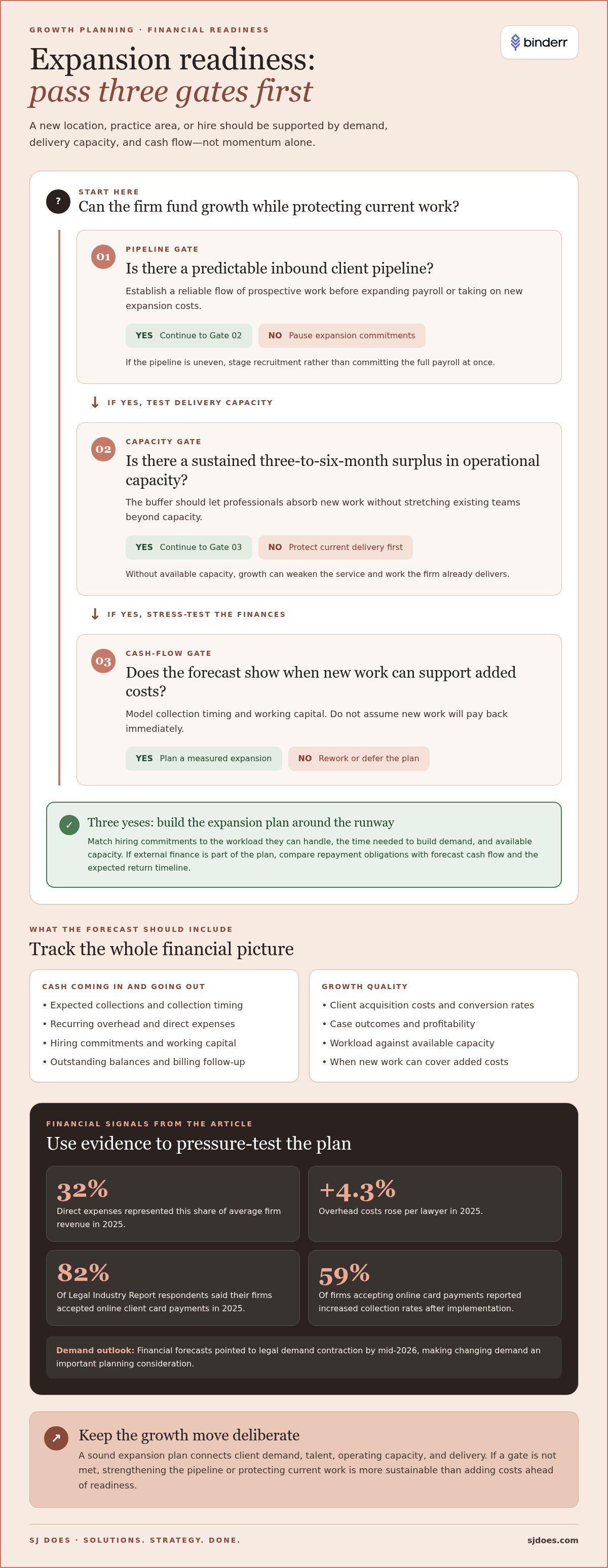
Expansion readiness means proving the firm can fund growth while protecting current work. Financial forecasts pointed to legal demand contraction by mid-2026, so plans need to account for changing demand. Before expanding payroll, establish a predictable inbound client pipeline and a sustained three-to-six-month surplus in operational capacity. That buffer gives professionals room to absorb new work without stretching existing teams beyond their capacity.
Start with a cash-flow forecast that separates recurring overhead, direct expenses, hiring commitments and expected collections. In 2025, direct expenses represented 32% of average firm revenue, while overhead costs rose 4.3% per lawyer. These measures help leaders test whether a new practice area or location can cover its operating needs. Track client acquisition costs, conversion rates, case outcomes and profitability together; revenue alone won’t show whether growth is sustainable.
Collection timing matters as much as billed work. In 2025, 82% of Legal Industry Report respondents said their firms accepted online credit and debit card payments from clients. Among firms accepting online card payments, 59% reported increased collection rates after implementation. Review payment options alongside billing follow-up and outstanding balances, then model how collection timing affects working capital. For external finance, compare the repayment obligations with forecast cash flow and the expected return timeline. The plan should show when new work can support added costs, not assume immediate payback.
Build hiring decisions around that runway. Compare the cost of a new role with the workload it can handle, the time needed to build demand, and available operational capacity. If the pipeline is uneven, stage recruitment rather than committing the full payroll at once. A targeted LinkedIn Content approach can support consistent visibility while the firm develops demand, but it should sit within a wider financial plan, not substitute for one.
Choosing between firm growth and specialisation
Growth can mean more clients, broader services, deeper expertise, or a stronger position in one market. The best route connects those ambitions to the firm’s capabilities and development priorities.
Defining Law Firm Growth
Law firm growth is a deliberate increase in reach, revenue, capability, or influence, not simply a larger headcount. That distinction matters because each growth path requires different resources and carries different risks.
A firm might add a practice area to serve existing clients or deepen a specialty to become known for complex work. A hybrid approach is also possible: build authority in a focused niche, then extend into related services where client needs and staff expertise overlap. Growth is meaningful when it strengthens the firm’s position without diluting service quality.
Growth Planning and Risk Management
Growth planning turns ambition into measurable actions, assigned responsibilities, and review points. For example, leaders can set revenue targets alongside goals for client relationships, visibility, and service development.
Mid-sized firms have a useful market signal: they captured nearly 5% demand growth, while Am Law 100 firms reached less than 2% in Q3 2025. That contrast supports assessing where the firm can compete, not assuming size determines opportunity. Prioritize a limited number of core sectors, then test each against market data, competitive conditions and internal expertise. A practical plan connects budgets, business development, staffing and knowledge management. It also identifies who oversees the work, so new activity doesn’t weaken existing performance.
Strategies Across Markets and Practice Areas
Expansion strategies depend on market size, location, client demand, and practice-area strengths. In a new geography, firms might open an office, hire laterally, or use remote teams. Within an established market, they might deepen a specialty or add related services.
The main strategies are geographic expansion, new service lines, lateral hiring, collaboration, and specialization. A firm can combine these selectively, such as developing a high-demand specialty before entering a new location. Market size affects the scale of the opportunity, while local client needs and the firm’s capabilities shape the right offer. Set specific, measurable, achievable, relevant, and time-bound goals, then review progress against both growth targets and service quality.
Blogging, social media, referrals, reviews, and local search
Entering a new market takes a connected marketing and business development plan. Use search-focused content, social media, referral relationships, reviews, and local search. First establish a clear position, then ensure every channel reinforces the same practice strengths and client value.
Blogging and SEO help prospective clients find useful answers before they know your firm. Choose a focused topic tied to a target client’s real questions, then publish practical guidance that demonstrates how your team approaches the issue. A regular LinkedIn article on a key industry topic can make that expertise more visible. Keep your website, articles, and service descriptions consistent so readers see the same strengths at every step.
Social media works best when it supports real professional relationships rather than disconnected posting. Choose a small number of business development channels that suit your strengths and clients. On LinkedIn, share concise insights, comment thoughtfully on relevant industry discussions, and align your profile with the firm’s market position. Client recommendations can add context, while a focused posting rhythm helps maintain visibility.
Referrals grow from useful connections and a positive client experience. Set a practical goal for building referral relationships, then stay in touch with professionals who serve similar clients. Reviews can reinforce confidence when they reflect genuine service experiences. For local search, keep location pages, contact details, and practice descriptions consistent across the firm’s online presence. Track inquiries by source, qualified leads, and resulting revenue to identify which activities contribute to market entry.
Responsiveness matters after visibility creates an inquiry. According to Hennessey Digital’s report, 25% of law firms responded to online leads in less than 5 minutes in 2025. Assign responsibility for incoming inquiries and review performance regularly. To connect your channels to a market-entry plan, build a focused law firm marketing strategy around your target clients and strengths.
SJ DOES: Strategy
SJ DOES helps law firms clarify growth priorities and shape a strategy for sustainable business development. Turn to this work when expansion options feel disconnected or a new market needs a sharper position, a realistic plan, and aligned action.
Strategy can connect the firm’s ambitions to its capabilities and commercial priorities. Marketing and LinkedIn Content can support visibility with a consistent message, while Legal Tech + AI can be part of the broader growth conversation. The value comes from making these choices reinforce one another rather than treating each as a separate initiative.
If your next move needs clearer direction, contact SJ DOES to discuss your firm’s growth priorities.
Make the Next Move Deliberate
A law firm market expansion strategy should guide a sequence of choices, not lock the firm into one direction. Treat each move as an opportunity to learn: observe how clients respond, whether the team can deliver consistently, and what the market signals next. Use those insights to refine the firm’s position before adding complexity. The strongest next step builds capability as well as reach.
SJ DOES connects strategic direction to practical action through Strategy, Marketing, and LinkedIn Content. These offerings support firms developing a growth plan, sharpening their market message, or building more consistent visibility around their expertise. The aim is alignment: a clear position, relevant communication, and growth priorities that work together.
Ready to put your firm’s next move into focus? Contact SJ DOES about your growth plans. A thoughtful next step can create momentum without losing sight of the firm you want to build.
Frequently Asked Questions
How do you measure the success of legal business development?
Measure whether business development creates suitable work and lasting client value, not just a busier calendar. Track how prospects move from first conversation to engagement, which sources produce the best-fit matters, and whether clients return or refer others. Compare results by practice area and channel over consistent review periods. A strong signal is repeatable work from relationships that fit the firm’s capabilities and commercial goals.
What steps should you take for growing your law practice?
Start by naming the outcome you want, such as stronger demand for a particular service or deeper relationships with existing clients. Choose a focused client group, identify the expertise and capacity required, and assign an owner to each development activity. For example, a practice seeking more work from technology companies could develop useful sector insights and test them through existing professional relationships before widening its outreach.
How should a law firm assess demand and competition in a new market?
Combine market research with direct conversations. Review how local firms describe their services, which client groups they target, and where their positioning overlaps. Then speak with prospective clients and referral contacts about recurring needs, service gaps, and what influences their choice of counsel. Compare those findings with your firm’s experience and delivery capacity. A market gap matters only if your firm can credibly serve it.
What are the costs and expected ROI of expanding a law firm into a new market?
Costs depend on the chosen route and the resources needed to deliver work there. Build a forecast that includes staffing, premises if relevant, marketing, technology, setup requirements, and working capital. Estimate when revenue could begin, how it might grow, and which assumptions drive the result. Compare projected contribution with ongoing commitments, then test scenarios with slower client acquisition or lower matter volume. The return depends on the economics of the specific plan.
How can a law firm identify target clients and practice areas in a new market?
Look for a practical overlap between client problems, your firm’s proven expertise, and work it can deliver consistently. Review existing matters for recurring needs, then compare those patterns with conversations in the target market. For example, several clients may face connected issues that call for a focused service offering. Prioritize client groups your firm can reach through credible relationships and give a clear reason to choose its approach.
What operational, technology, and staffing steps are needed to expand a law firm?
Prepare the people and systems that will support new work before demand rises. Clarify who leads the market effort, who handles intake and client updates, and how teams share knowledge across locations. Map the tools needed for matter tracking, collaboration, and reporting, then train staff on consistent workflows. A small pilot can reveal handoff delays or information gaps early, giving leaders time to refine operations before scaling the model.

